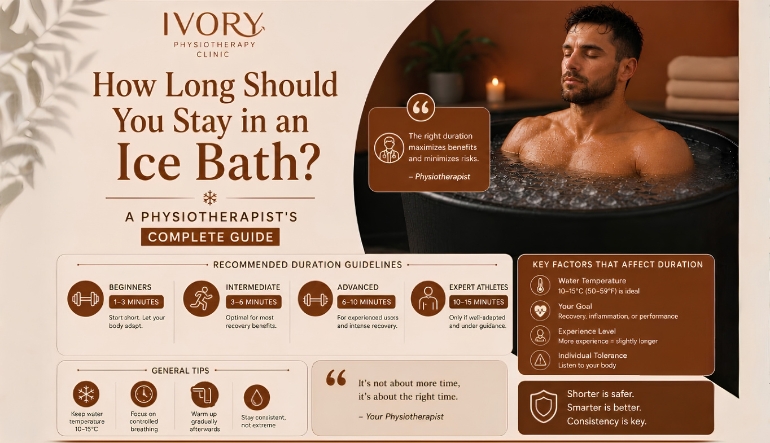
How Long Should You Stay in an Ice Bath? A Physiotherapist's Complete Guide
Ice baths have become one of the most popular recovery methods among athletes, runners, and gym enthusiasts. But one question comes up repeatedly:
How long should you stay in an ice bath?
Many people believe that staying in longer provides greater benefits. In reality, that's not true.
An ice bath is effective only when both the water temperature and duration are carefully controlled. Staying in too long or using extremely cold water can increase the risk of unwanted side effects without providing additional recovery benefits.
What Is the Ideal Ice Bath Duration?
Most sports medicine and physiotherapy guidelines recommend:
| Factor | Recommended Range |
|---|---|
| Ice bath duration | 10 to 15 minutes |
| Ice bath temperature | 10°C to 15°C |
| Best time after exercise | Within 30 to 60 minutes (when appropriate) |
For most healthy adults, this range provides recovery benefits while minimizing unnecessary risks.
Why Staying Longer Is Not Better
Cold water slows nerve activity and reduces inflammation, but after a certain point the benefits begin to plateau.
| Time in Ice Bath | What Happens |
|---|---|
| 1 to 3 minutes | Body adapts to cold |
| 5 to 10 minutes | Muscles cool and soreness begins to reduce |
| 10 to 15 minutes | Maximum recovery benefits for most people |
| More than 15 to 20 minutes | Increased risk with little additional benefit |
Longer sessions do not mean faster recovery.
Choosing the Right Ice Bath Temperature
The temperature is just as important as the duration.
| Water Temperature | Recommendation |
|---|---|
| Below 10°C | Too cold for most people |
| 10°C to 15°C | Ideal range for recovery |
| Above 15°C | Recovery effect may be reduced |
Using water that is extremely cold increases discomfort without necessarily improving recovery.
Ice Bath Duration Based on Experience
| Experience Level | Recommended Duration |
|---|---|
| First-time user | 5 to 8 minutes |
| Recreational athlete | 8 to 12 minutes |
| Experienced athlete | 10 to 15 minutes |
Beginners should gradually increase exposure rather than starting with the maximum duration.
When Should You Take an Ice Bath?
| Situation | Is an Ice Bath Helpful? |
|---|---|
| Marathon or endurance event | Yes |
| Heavy leg workout | Yes |
| High-intensity interval training | Yes |
| Sports tournament with multiple matches | Yes |
| Light gym session | Usually not necessary |
Ice baths are most useful after intense exercise that causes significant muscle soreness.
Signs You Should Get Out Immediately
Never force yourself to stay in an ice bath.
Exit immediately if you experience:
| Symptom | Action |
|---|---|
| Severe pain | Leave the bath |
| Dizziness | Stop immediately |
| Chest discomfort | Seek medical attention |
| Difficulty breathing | Exit immediately |
| Excessive numbness | End the session |
Recovery should never come at the cost of your safety.
Common Mistakes People Make
| Mistake | Why It Is a Problem |
|---|---|
| Staying longer than 20 minutes | Higher risk without extra benefits |
| Water that's too cold | Increased discomfort and risk |
| Using an ice bath after every strength workout | May reduce muscle-building adaptations |
| Skipping warm-up after recovery | Muscles may remain stiff |
| Ignoring medical conditions | Can increase health risks |
What to Do After an Ice Bath
Recovery doesn't end when you step out of the tub.
| Aftercare Step | Benefit |
|---|---|
| Dry off and warm up naturally | Restores body temperature |
| Drink water | Replaces lost fluids |
| Light walking | Encourages circulation |
| Gentle mobility exercises | Reduces stiffness |
| Eat a balanced recovery meal | Supports muscle repair |
Avoid jumping into very hot water immediately after an ice bath, as sudden temperature changes may be uncomfortable for some individuals.
Ice Bath vs Active Recovery
| Ice Bath | Active Recovery |
|---|---|
| Reduces soreness | Improves circulation |
| Controls inflammation | Maintains flexibility |
| Best after intense exercise | Best after moderate exercise |
| Passive recovery | Movement-based recovery |
Both methods have their place and are often used together.
Why Physiotherapy Is More Than Recovery
An ice bath helps reduce muscle soreness, but it does not identify why injuries occur.
If soreness keeps returning or pain becomes persistent, the underlying issue may be poor movement mechanics, muscle imbalance, or inadequate recovery planning.
Physiotherapy addresses these root causes.
| Physiotherapy Treatment | Benefit |
|---|---|
| Movement assessment | Identifies injury risk |
| Manual therapy | Restores mobility |
| Strength training | Improves muscle support |
| Corrective exercises | Prevents recurring injuries |
| Recovery planning | Optimizes performance |
Ivory Physiotherapy Clinic, Seawoods
At Ivory Physiotherapy Clinic in Seawoods, recovery programs are tailored to each individual's sport, training load, and physical condition.
Led by Dr. Nishita Madaan and supported by an experienced team of physiotherapists, the clinic provides evidence-based rehabilitation for athletes, runners, fitness enthusiasts, and individuals recovering from musculoskeletal injuries.
The team combines movement assessment, manual therapy, rehabilitation exercises, and sports recovery strategies to help patients recover safely and perform at their best.
Why Choose Ivory Physiotherapy Clinic?
| Feature | Benefit |
|---|---|
| Comprehensive assessment | Identifies the true cause of pain |
| Personalized rehabilitation plans | Faster recovery |
| Manual therapy | Reduces pain and stiffness |
| Sports rehabilitation | Improves athletic performance |
| Team based physiotherapy care | Long-term injury prevention |
Conclusion
The ideal ice bath duration is not about staying in as long as possible. The combination of 10 to 15 minutes in water between 10°C and 15°C provides the best balance between recovery and safety for most healthy adults.
When combined with proper nutrition, sleep, structured training, and physiotherapy, ice baths can be a valuable part of an overall recovery plan.
Schedule Appointment
Book your consultation with Dr. Nishita Madaan and the physiotherapy team.
Call 85911 26927
Get expert guidance on sports recovery, injury prevention, and personalized physiotherapy to help you recover faster and perform better.