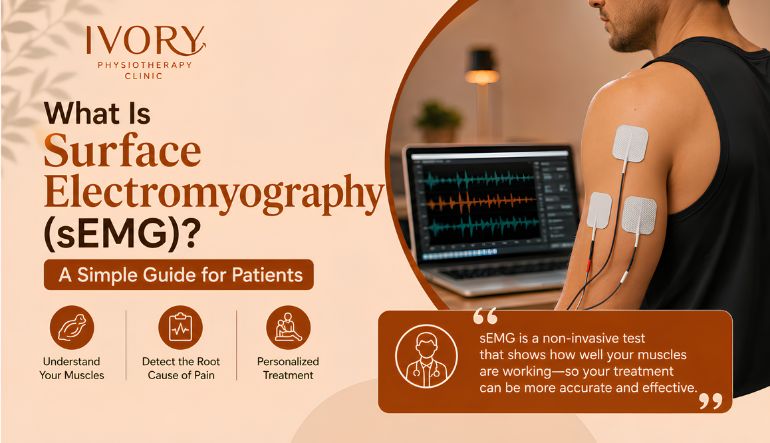
What Is Surface Electromyography (sEMG)? A Simple Guide for Patients
Have you ever wondered why your pain keeps returning even after medication, exercise, or physiotherapy?
Sometimes the problem isn't where you feel pain. It's because certain muscles are working too hard while others are weak or not activating properly.
This is where Surface Electromyography (sEMG) helps.
An sEMG test gives physiotherapists objective information about how your muscles work, helping them identify problems that cannot be seen during a routine physical examination.
What Is Surface Electromyography (sEMG)?
Surface Electromyography (sEMG) is a non-invasive muscle activity test that records the electrical signals produced by muscles during movement.
Unlike needle electromyography, surface electromyography uses small adhesive sensors placed on the skin. There are no needles, injections, or surgery involved.
The test is painless, safe, and performed while you move naturally.
How Does an sEMG Test Work?
During the assessment, sensors are placed over specific muscles. As you perform simple movements, the sensors record electrical activity generated by your muscles.
The results are displayed in real time, allowing physiotherapists to evaluate how your muscles work together.
| Step | What Happens |
|---|---|
| Sensor placement | Adhesive sensors placed on the skin |
| Movement assessment | Simple movements are performed |
| Muscle recording | Electrical muscle activity is measured |
| Data analysis | Muscle performance is evaluated |
The entire process is comfortable and usually completed within a single appointment.
What Does sEMG Measure?
An electromyography physiotherapy assessment provides valuable information about muscle function.
| Measurement | Why It Matters |
|---|---|
| Muscle activation | Identifies muscles that are not working properly |
| Muscle coordination | Shows how muscles work together |
| Muscle fatigue | Detects early muscle exhaustion |
| Muscle symmetry | Compares left and right sides |
| Compensation patterns | Identifies hidden movement problems |
This information helps physiotherapists develop more accurate treatment plans.
Who Can Benefit from an sEMG Test?
Surface electromyography can be helpful for many conditions.
| Condition | Benefit |
|---|---|
| Chronic muscle pain | Identifies muscle imbalance |
| Neck and back pain | Detects poor muscle activation |
| Sports injuries | Improves rehabilitation |
| Knee pain | Evaluates muscle weakness |
| Shoulder pain | Assesses stabilizing muscles |
| Post-surgical rehabilitation | Tracks recovery progress |
| Recurrent injuries | Identifies movement compensation |
Athletes, office workers, older adults, and people with long-standing pain can all benefit from muscle activity assessment.
Traditional Assessment vs sEMG-Guided Assessment
| Traditional Assessment | sEMG-Guided Assessment |
|---|---|
| Relies on observation | Measures muscle activity objectively |
| Therapist experience based | Real-time muscle data |
| Hidden dysfunction may be missed | Identifies overactive and underactive muscles |
| General exercise prescription | Personalized rehabilitation |
An sEMG assessment adds objective information that helps improve treatment accuracy.
Why Is sEMG Important in Physiotherapy?
Many patients repeatedly treat pain without knowing which muscle is actually causing the problem.
A painful muscle is often compensating for another muscle that is weak or not activating correctly.
Using sEMG allows physiotherapists to identify these hidden problems early and create rehabilitation programs based on objective findings instead of assumptions.
Ivory Physiotherapy Clinic, Seawoods
Ivory Physiotherapy Clinic in Seawoods is among the few centers in India offering advanced MyoAct Surface Electromyography (sEMG) assessment for precise muscle evaluation.
Led by Dr. Nishita Madaan and supported by an experienced team of physiotherapists, the clinic combines advanced muscle activity testing with detailed clinical assessment to identify the true cause of pain and movement dysfunction.
The information obtained through MyoAct sEMG helps the team create personalized rehabilitation programs that improve muscle activation, correct movement patterns, reduce chronic pain, and lower the risk of recurring injuries.
Why Choose Ivory Physiotherapy Clinic?
| Feature | Benefit |
|---|---|
| MyoAct Surface EMG technology | Precise muscle activity assessment |
| Comprehensive physiotherapy evaluation | Accurate diagnosis |
| Personalized treatment plans | Faster and targeted recovery |
| Evidence-based rehabilitation | Better long-term outcomes |
| Team based physiotherapy care | Continuous monitoring and progress tracking |
Clinic Results
| Achievement | Outcome |
|---|---|
| 10,000 plus patients treated | Trusted physiotherapy care |
| 5,000 plus surgeries prevented | Strong conservative treatment outcomes |
| Advanced sEMG technology | Objective muscle assessment |
Frequently Asked Questions
Is an sEMG test painful?
No. Sensors are placed on the skin, making the test completely non-invasive.
How long does the test take?
Most assessments are completed within 30 to 60 minutes, depending on the condition being evaluated.
Can sEMG diagnose muscle weakness?
It helps identify abnormal muscle activation, weakness, fatigue, and coordination issues, which are interpreted along with a clinical assessment.
Is sEMG safe?
Yes. Surface electromyography is a safe and widely used assessment technique in physiotherapy and rehabilitation.
Conclusion
If you've been struggling with recurring pain, muscle weakness, or repeated injuries, treating symptoms alone may not be enough.
A Surface Electromyography (sEMG) test provides valuable insights into how your muscles function, helping physiotherapists identify hidden muscle imbalances and create personalized rehabilitation programs based on objective data.
Schedule Appointment
Book your consultation with Dr. Nishita Madaan and the physiotherapy team.
Experience advanced MyoAct Surface Electromyography (sEMG) assessment and receive a personalized treatment plan designed to restore healthy movement and lasting pain relief.